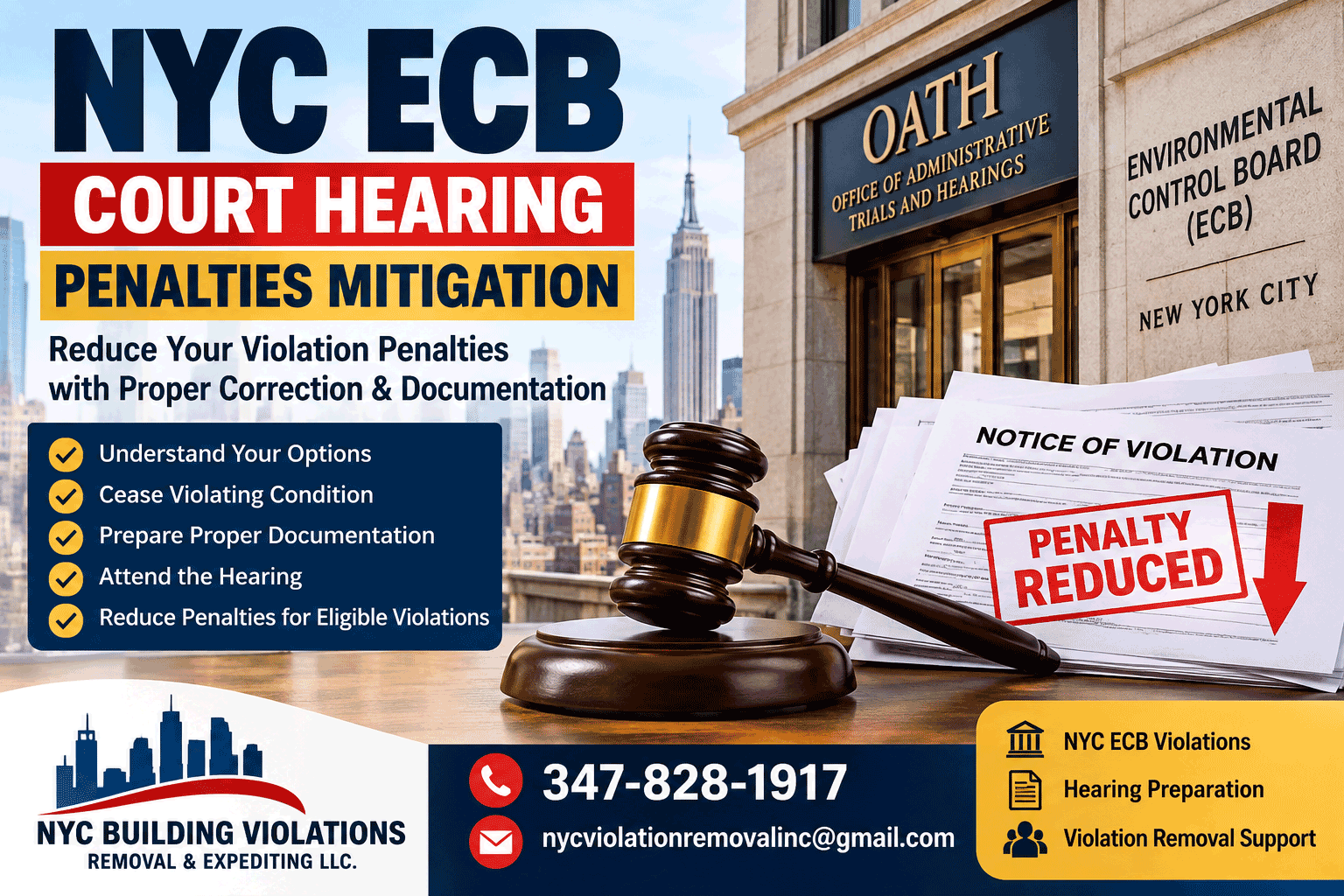
Receiving an Environmental Control Board (ECB) violation in New York City can create significant financial and compliance concerns for property owners, landlords, businesses, contractors, and other respondents. Understanding ECB court hearing penalties mitigation can help eligible respondents understand their available options before appearing at an OATH hearing.
What Is ECB Penalty Mitigation in NYC?
The Environmental Control Board (ECB) is now part of the New York City Office of Administrative Trials and Hearings (OATH). ECB violations are handled through the City's administrative hearing process.
For certain eligible violations, a respondent may be able to receive a mitigated penalty if the violating condition was corrected before the first scheduled hearing and the respondent can establish the correction at the hearing.
NYC Department of Buildings guidance states that mitigation is available only for violations identified as eligible under the applicable penalty schedule. For eligible violations, the mitigated penalty is generally one-half of the penalty that would otherwise be imposed at a hearing.
How Does NYC ECB Penalty Mitigation Work?
The basic process generally involves identifying the violation, correcting the condition, gathering proof of correction, and appearing at the scheduled hearing when required.
- Review the Notice of Violation: Determine the violation type, infraction code, hearing date, classification, and applicable penalty provisions.
- Correct the violating condition: Take the appropriate steps to correct the condition identified in the Notice of Violation.
- Gather documentation: Depending on the violation, useful documentation may include photographs, permits, inspection records, invoices, professional reports, certificates, and other evidence demonstrating correction.
- Certify the correction when required: NYC Buildings may require an acceptable Certificate of Correction.
- Attend the hearing if necessary: If mitigation is being requested at an OATH hearing, the respondent may need to appear and establish that the condition was corrected before the first scheduled hearing date.
When Can an ECB Violation Receive a Mitigated Penalty?
Not every NYC ECB/OATH violation qualifies for mitigation. Eligibility depends on the specific violation and the applicable NYC penalty schedule.
For eligible violations, NYC rules provide that the respondent may establish at the hearing that the violating condition was corrected before the first scheduled hearing. If the requirements are satisfied, a reduced penalty may be imposed.
According to NYC Department of Buildings guidance, the mitigated penalty is generally one-half of the standard hearing penalty.
Why Correcting the Violation Before the Hearing Matters
Timing can be important in an ECB/OATH violation case. Correcting the condition before the first scheduled hearing may provide an opportunity for penalty mitigation when the violation is eligible.
Property owners should not assume that simply correcting a condition automatically eliminates the violation or penalty. The correction may need to be properly documented and certified, and the specific violation must qualify for the applicable resolution option.
Documents That May Help at an NYC ECB Hearing
Proper documentation can be important when demonstrating that a violation has been corrected. Depending on the circumstances, documentation may include:
- Before-and-after photographs
- Certificate of Correction
- Approved permits
- Inspection reports
- Architect or engineer documentation
- Licensed contractor documentation
- Invoices and receipts for corrective work
- Proof of completed repairs
- Agency correspondence
- Other records supporting compliance
The documents needed depend on the violation and the agency that issued it. Documentation should directly address the condition described in the Notice of Violation.
ECB Mitigation vs. Cure vs. Stipulation
NYC provides several possible ways to resolve certain violations. These options should not be confused with one another.
ECB Cure
Certain eligible violations may qualify for a cure. When an eligible violation is corrected and an acceptable certification is submitted within the required cure period, the hearing and penalty may be waived.
Penalty Mitigation
Mitigation generally involves attending the hearing for an eligible violation and demonstrating that the violating condition was corrected before the first scheduled hearing. The resulting penalty may be reduced, generally to one-half of the standard hearing penalty.
Stipulation
Certain violations may also qualify for a stipulation. Under a stipulation, the respondent admits the violation and receives additional time to correct the condition. NYC guidance states that a pre-hearing stipulation generally carries a reduced penalty and provides additional time for correction.
What Happens If You Do Not Attend the ECB Hearing?
Ignoring an NYC OATH/ECB hearing can result in a default. NYC Buildings states that default penalties can be substantially higher than the standard penalty. Respondents should therefore pay close attention to the hearing date and resolution options shown on the violation.
If you cannot attend a scheduled hearing, review the official NYC procedures for the violation and determine whether a representative, rescheduling, admission, stipulation, or another available option applies.
Common NYC Violations That May Involve ECB/OATH Hearings
NYC property owners and businesses may encounter administrative violations involving different areas of building and property compliance, including:
- DOB Violations
- Construction Code Violations
- Zoning Violations
- Electrical Violations
- Safety-related violations
- Permit-related violations
- Work Without Permit violations
- Stop Work Order-related violations
- Property maintenance violations
- Other NYC agency violations adjudicated through OATH
The available penalty reduction or resolution option depends on the exact violation, classification, penalty schedule, and circumstances of the case.
How NYC Property Owners Can Prepare for an ECB Hearing
Preparing early can help organize the information needed for a hearing or other resolution process.
- Review the Notice of Violation carefully.
- Identify the violation code and classification.
- Check the hearing date and any cure date.
- Determine whether the violation is eligible for mitigation, cure, or stipulation.
- Correct the condition as quickly as practical.
- Collect photographs and supporting documentation.
- Complete required certifications.
- Prepare a clear explanation of the corrective work.
- Attend the hearing or follow the applicable resolution procedure.
Professional Help With NYC ECB Violation Penalties
Dealing with an NYC ECB/OATH violation can involve deadlines, documentation, correction work, agency requirements, and hearing procedures. A violation professional can help property owners understand the paperwork and organize documentation related to the correction process.
NYC BUILDING VIOLATIONS REMOVAL & EXPEDITING LLC. assists property owners and businesses with NYC building violation-related services, including violation resolution and expediting support.
If you have an NYC ECB/OATH violation and want to understand the available options for correction, mitigation, or other resolution procedures, contact our team for information about your case.
Contact NYC Building Violation Removal & Expediting LLC.
Company: NYC BUILDING VIOLATIONS REMOVAL & EXPEDITING LLC.
Email: nycviolationremovalinc@gmail.com
Phone: 347-828-1917
Service Area: New York City — Manhattan, Brooklyn, Queens, Bronx, and Staten Island.
Frequently Asked Questions About NYC ECB Penalty Mitigation
Can an NYC ECB penalty be reduced?
Certain violations may qualify for a mitigated penalty if the requirements under the applicable NYC penalty schedule are satisfied. For eligible cases, the mitigated penalty is generally one-half of the standard hearing penalty.
Do I need to correct the violation before the hearing?
For mitigation, the respondent generally must demonstrate that the violating condition was corrected before the first scheduled hearing. Other resolution options, such as cure or stipulation, have their own requirements and deadlines.
Does fixing an ECB violation automatically remove the penalty?
No. Correction does not automatically mean that every penalty is eliminated. The available result depends on the violation and whether it qualifies for cure, mitigation, stipulation, dismissal, or another resolution option.
What is the difference between mitigation and cure?
A cure can result in the hearing and penalty being waived when an eligible violation is corrected and properly certified within the applicable cure period. Mitigation generally results in a reduced penalty for an eligible violation when correction is established before the first scheduled hearing.
Can I challenge an NYC ECB violation?
Yes. Respondents generally have the right to present a defense at a scheduled OATH hearing. The Administrative Law Judge may dismiss the violation or find the respondent in violation based on the evidence and applicable rules.
Conclusion
NYC ECB court hearing penalty mitigation can be an important option for respondents with eligible violations. Correcting the violating condition before the first scheduled hearing, maintaining appropriate documentation, and understanding the applicable penalty schedule can help ensure that available resolution options are properly considered.
Because eligibility varies by violation, property owners should review the specific Notice of Violation and applicable NYC requirements rather than assuming that mitigation will apply.
For assistance with NYC building violations and violation resolution, contact NYC BUILDING VIOLATIONS REMOVAL & EXPEDITING LLC. at 347-828-1917 or nycviolationremovalinc@gmail.com.